
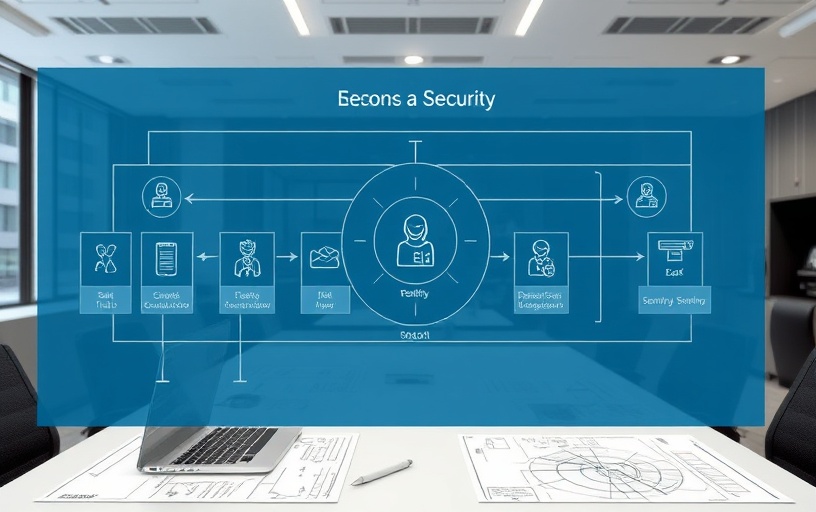
Introduction: The end of the traditional perimeter
For years, corporate security was based on the concept of "trust within, distrust out." However, accelerated digitalization, the adoption of cloud services and the The growth of remote access has completely blurred the classic perimeter.
In 2026, organizations face advanced threats that exploit valid credentials, silent lateral movements and compromised legitimate access. En este escenario, la arquitectura Zero Trust redefine el paradigma bajo un principio simple pero contundente:
Never trust, always verify.
The Zero Trust approach is not a product, it is a strategic model aligned with frameworks such as National Institute of Standards and Technology (NIST SP 800-207) and adopted by manufacturers leaders such as Microsoft, Google and Palo Alto Networks.
What is Zero Trust?
Zero Trust es un modelo de seguridad que elimina la confianza implícita en la red interna. Each access request must be authenticated, authorized and validated continuously, without no matter where it comes from.
Fundamental principles:
- Continuous identity verification
- Minimum necessary access (Least Privilege)
- Granular segmentation
- Permanent monitoring and analysis
- Assume Breach
This model integrates identity, devices, applications, network and data in a schema dynamic validation based on context and risk.
Key components of a Zero Trust architecture
1️⃣ Identity and Access Management (IAM)
Identity is the new perimeter.
Associated technologies:
- Multi-factor authentication (MFA)
- Single Sign-On (SSO)
- Conditional access control
- Privilege Management (PAM)
Validation is not just credential + password; includes device posture, location, behavior and risk level.
2️⃣ Network microsegmentation
Microsegmentation reduces lateral movement. Instead of a flat network, zones are created controlled with specific policies per application or workload.
Benefits:
- Incident containment
- Reducing the impact of ransomware
- Granular east-west traffic control
3️⃣ Endpoint Security
Each device must be validated before allowing access.
Includes:
- EDR/XDR
- Endpoint posture control
- Disk encryption
- Patch management
Access may be automatically blocked if the device does not meet minimum policies.
4️⃣ Data protection
Zero Trust protects access, but also the data itself:
- Information classification
- DLP (Data Loss Prevention)
- Encryption in transit and at rest
- Tokenization
Security stops focusing only on infrastructure and focuses on critical information.
Step by step implementation
Phase 1: Maturity Assessment
- Asset Inventory
- Identification of critical flows
- Evaluation of current controls
- Gap analysis
An initial diagnosis allows us to define the realistic roadmap.
Phase 2: Define the protection surface
Instead of protecting the entire network, the following are prioritized:
- Sensitive data
- Critical applications
- Key infrastructure
- Strategic services
Phase 3: Design policies based on identity and context
Policies must consider:
- User role
- Device type
- Geographic location
- Dynamic risk level
Example: An administrator can access from Paraguay during working hours with a device corporate, but not from non-validated foreign IP.
Phase 4: Gradual technological implementation
Not everything is replaced immediately. Recommended order:
- Mandatory MFA
- Critical network segmentation
- SIEM + EDR integration
- Conditional access
- Response automation
Phase 5: Monitoring and continuous improvement
Zero Trust is not a 6 month project. It is a permanent operating model.
Key indicators:
- Detection time (MTTD)
- Response time (MTTR)
- Access attempts blocked
- Lateral movements detected
Strategic benefits for Senior Management
For Level C, Zero Trust is not just technology; is risk management:
- ✔ Reduction of the financial impact of incidents
- ✔ Greater regulatory compliance
- ✔ Corporate reputation protection
- ✔ Operational resilience
In markets such as Paraguay and LATAM, where security maturity is still heterogeneous, adopting Zero Trust positions the organization as a benchmark in cyber resilience.
Common challenges in its adoption
- Internal cultural resistance
- Legacy infrastructure
- Lack of updated inventory
- Integration between multiple solutions
- Underestimation of the human factor
Successful implementation requires executive leadership and strategic alignment with the IT governance.
Zero Trust and the future of cyber defense
The evolution of remote work, hybrid cloud and offensive artificial intelligence make that Zero Trust evolves towards autonomous risk-based decision models in time real.
Organizations that implement Zero Trust in a structured way will not only be better off protected, but they will also be prepared to:
- Security automation with AI
- SASE architectures
- Multicloud environments
- Resilient critical infrastructures
Conclusion
Zero Trust is not a technology fad; It is the strategic response to an environment where implicit trust ceased to exist.
Implementing it correctly involves executive vision, operational discipline and alignment with international standards. Companies that adopt this model progressively and structured will strengthen your security posture, reduce your attack surface and They will guarantee operational continuity in an increasingly hostile digital environment.
The question is no longer whether to implement Zero Trust.
The question is when to start.
—Mg. Lic. Héctor Aguirre